
Related activities
Why you need a map
The Baths of Diocletian cover an area of about 13 hectares, but not all of it is open to the public. The original archaeological complex has been fragmented over the centuries: one part became a basilica (Santa Maria degli Angeli), one part houses the Planetarium, and another part is outdoors on Piazza della Repubblica. The actual museum occupies the northeastern quadrant, around the large Cloister of Michelangelo. Understanding the plan before you enter saves time and helps you not miss the main halls.
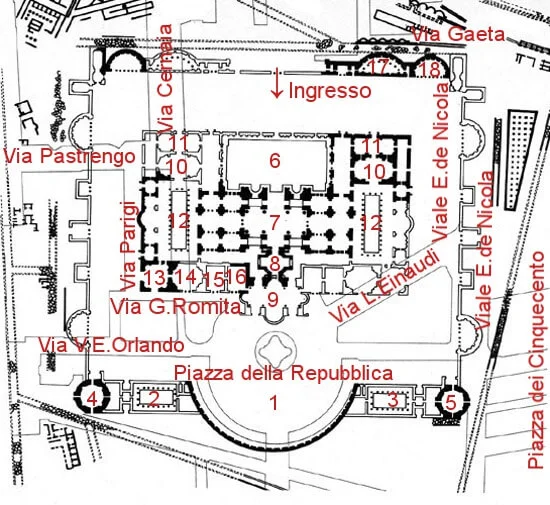
The four cardinal points of the complex
To navigate, it helps to keep in mind four visual landmarks at the ideal corners of the plan.
1. Main entrance — Viale Enrico de Nicola 78
This is the museum entrance. Here you'll find the ticket office, security checks, cloakroom (free for backpacks and umbrellas) and bookshop. It faces directly onto Piazza dei Cinquecento, in front of Termini Station. From here the exhibition route begins.
2. Basilica of Santa Maria degli Angeli — Piazza della Repubblica
On the opposite side of the complex. It is the ancient frigidarium and tepidarium transformed into a church by Michelangelo. Independent entrance, free admission. Not part of the museum ticket but is the best-preserved monumental section.
3. Aula Ottagona — Via Romita
An octagonal hall with a dome, today used for temporary exhibitions. It is visible from the outside and has a separate entrance that opens on specific occasions.
4. Planetarium — Piazza dei Cinquecento
Another large bath hall converted into an astronomical exhibition space in the 1920s. It is currently undergoing restoration; check the official museum website for eventual reopening.
The museum sections
Once you enter from the main entrance, the route unfolds on two levels and crosses five main areas.
| Section | What it contains | Suggested time |
|---|---|---|
| Cloister of Michelangelo | Sculptures, sarcophagi, statues in the open air | 25–35 min |
| Epigraphic section | Over 10,000 Latin inscriptions, thematic itinerary | 30–45 min |
| Protohistory of Latium | Burial assemblages, vases, objects from the Bronze Age to the archaic period | 20–30 min |
| Small cloister (Ludovisi) | Restored statues, garden-museum | 10–15 min |
| Bath halls | Original vaults, monumental spaces | 20–30 min |
Recommended visit route
The museum can be walked in different orders. This itinerary, based on practical experience, alternates large spaces and details to avoid museum fatigue.
- Atrium and Cloister of Michelangelo — enter, leave your backpacks at the cloakroom, then cross the cloister to get an overall impression.
- Northern bath halls — here the vaults reach 27 meters. Look up: the ancients did not build to hide.
- Protohistoric section (ground floor) — burial assemblages and everyday objects. It provides perspective on the 1500 years that preceded Diocletian.
- Epigraphic section (upper floor) — a fundamental section. Even without Latin, the reconstructions and captions tell the story of "ordinary" Rome.
- Small cloister (Ludovisi) — ideal conclusion. Few statues, but carefully selected, and a garden where you can sit before leaving.
Accessibility and alternative routes
The museum is largely accessible for people with reduced mobility. Ramps and elevators are available for the two-level route. Some areas — especially the outdoor archaeological remains — have uneven pavements in opus spicatum or ancient cobblestones: in these sections accompanied access is recommended. Wheelchairs are available free at the ticket office, subject to availability. Accessible bathrooms in the large cloister, near the bookshop.
Services on the map
- Ticket office: main entrance (Viale E. de Nicola 78).
- Cloakroom: just after the security check. Free for backpacks, umbrellas and small bags.
- Bookshop: between the atrium and the large cloister. Catalogs, books, merchandise.
- Bathrooms: in the large cloister and on the upper floor.
- Free WiFi: in common areas (Museitaliani network).
- Water fountains: in Piazza dei Cinquecento and Piazza della Repubblica (Rome's drinking water).
The "human" map: what everyone photographs
If you came to take home some memorable shots, these are the four most sought-after locations by photographers.
- Michelangelo's Cloister in morning sunlight — the low-angle light on the colonnade creates striking shadows.
- Portonaccio Sarcophagus — the battle relief is the most photographed piece in the museum.
- The vaults of the bath halls — a vertical shot from below conveys the monumental scale.
- The garden of the Ludovisi Cloister — at sunset, with warm light on the statues.
Neighborhood map: what's around
The Baths are at the center of a very dense area of monuments. Many sites reachable in 10 minutes on foot, often underestimated by tourists.
- Palazzo Massimo alle Terme (200 m) — the "sister" to the Baths of Diocletian, with the frescoes from the Villa of Livia.
- Basilica of Santa Maria degli Angeli (300 m) — Michelangelo's basilica within the baths themselves.
- Termini Station (100 m) — main transit hub.
- Piazza della Repubblica (250 m) — Fountain of the Naiads.
- Basilica of Santa Maria Maggiore (800 m) — one of the four papal basilicas.
- Mercato Centrale Roma (200 m) — lunch or dinner before/after your visit.
How the plan of today was formed
The current shape of the complex results from millennia of layering. The original plan was a perfect rectangle of 376 × 361 meters, with a central building (the baths proper) and an outer enclosure that housed gymnasiums, libraries, gardens and exedras. Today the central building is largely preserved; the outer enclosure has almost disappeared, but traces remain in the surrounding streets — Via Volturno, Via Cernaia, Via XX Settembre follow the ancient perimeter in many stretches.
Three events have shaped the plan we see today:
- 1561: Pope Pius IV commissions Michelangelo to transform the frigidarium into a basilica. A huge portion of the complex exits the archaeological circuit and enters the religious one.
- 1889: founding of the Museo Nazionale Romano. The remaining bath halls become exhibition space for artifacts from new discoveries linked to Rome as a capital.
- 2014: administrative separation of the four MNR sites (Baths, Palazzo Massimo, Palazzo Altemps, Crypta Balbi) under unified management but with independent routes.
Downloadable map and practical questions
The museum provides free at the ticket office a bilingual printed plan (Italian/English), useful for navigating without a connection. An official Ministry of Culture app ("MuseiItaliani") is also available, which includes the plan in three languages. For deeper preparation, the website museonazionaleromano.it provides PDF plans of each section.
Frequently asked questions about the map
Is the Basilica of Santa Maria degli Angeli included in the visit?
No, it has an independent and free entrance. We still recommend entering: it is the best-preserved part of the original baths.
Can I do a shortened route if I have less than an hour?
Yes. Quick route: Large Cloister → Bath halls → Epigraphic section (first halls only). Time: 45–60 minutes.
Are maps in other languages available?
Yes, the printed map is bilingual (IT/EN). The official website has versions in French and Spanish as well.
Can I bring a stroller?
Yes, the museum is stroller-accessible. Some archaeological courtyards have uneven pavements, but they can be navigated around.